


Meet Anthony
In 2009, Wired magazine described Anthony Rose as “the man who saved the BBC”.
To say he’s not your usual legal technology founder is an understatement.
As a teenager in Cape Town, he made circuit boards in his study. One day he took his boards into the local Apple store, in the era of the Apple II. They wanted to buy 20 of them. His first business was born.
The hardware business took him from South Africa to Australia, morphed into real-time 3D graphics, and then into something that would put him at the centre of one of the defining tech battles of the era: Kazaa, the peer-to-peer file sharing company.
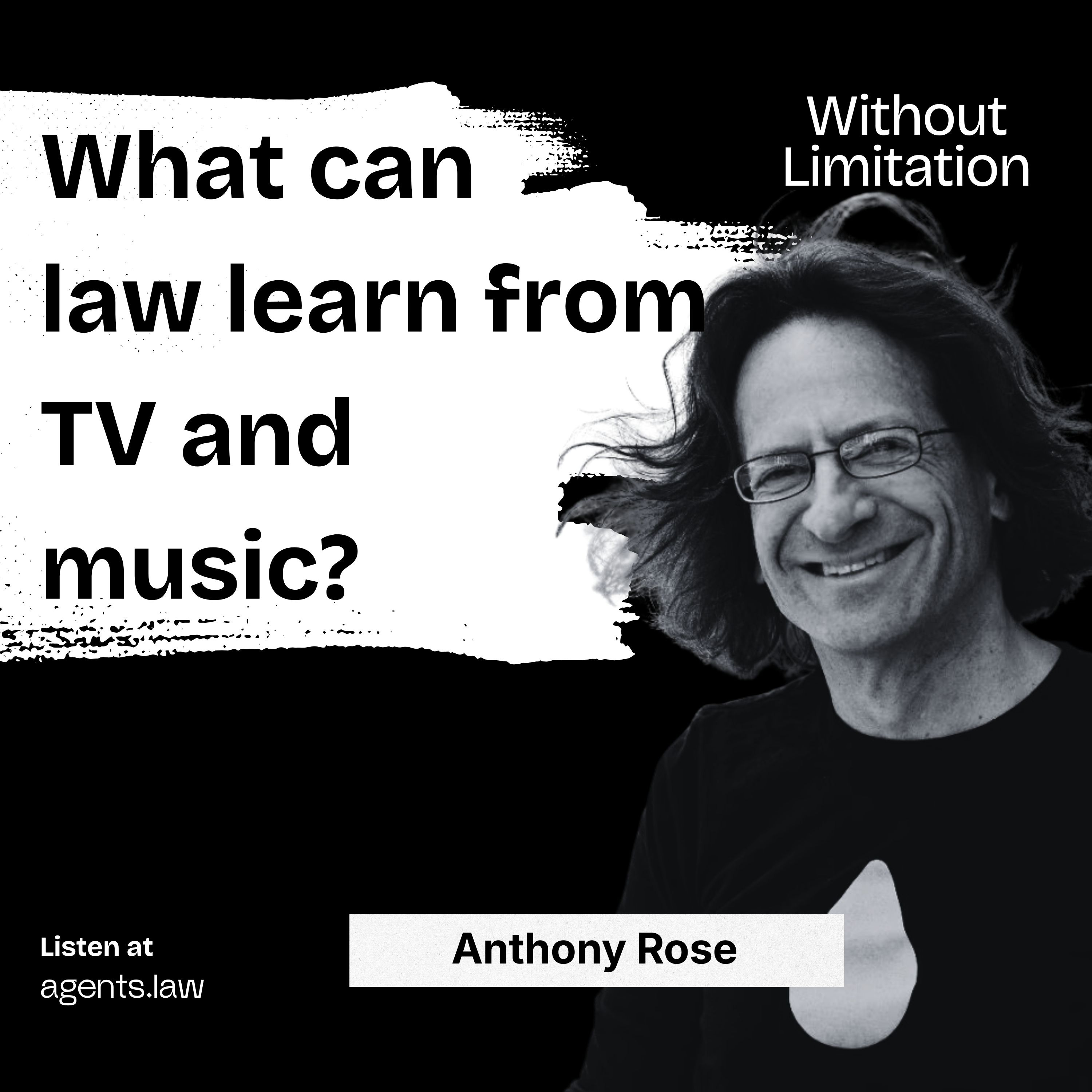
Exhibit A
If you want to understand how Anthony thinks about the legal industry today, you have to start with the music industry in the early 2000s.
CD sales were a $10 billion a year business, declining by a billion dollars a year as the internet rose. Anthony was in New York, sitting across the table from music label executives, telling them that in the time it took to read his PowerPoint, 100,000 of their tracks had been downloaded, and they could have monetised every one of them. Instead of signing a licensing deal, he says they made his pitch “Exhibit A” by suing Kazaa, and losing the revenue anyway.
The labels spent enormous sums trying to litigate file sharing out of existence rather than reinvent themselves. Cut to today: almost nobody buys CDs, and the overwhelming majority of music revenue comes from streaming. As Anthony puts it, the revenue needed to decrease to force change. While the revenue is good, nobody wants to change.
He’s watched the same pattern play out three times now. Music was the first. Broadcasting was the second (we’ll come onto that). Law, he believes, is the third.
The chocolate box test
Between Kazaa and SeedLegals came the chapter that earned Anthony that Wired headline. Full disclosure: I spent time at the BBC early in my career and I’m very fond of it, so this part of the conversation was a treat.
Anthony was hired in 2007 to take iPlayer from years of internal noodling to an actual launch, in three months, with failure not an option. His first instinct was that the tech team must be the problem, because nothing worked. What he found was the opposite: a brilliant tech team being pulled in every direction by an organisation not orientated around the customer. BBC One wanted a BBC One player. BBC Two wanted a BBC Two player. The distribution department wanted to save money with a low-quality peer-to-peer system. Nobody was aligned around the viewer.
So Anthony appointed himself customer champion and invented what he calls the chocolate box test. Quoted £20,000 and six weeks for formal user testing, he went to the supermarket instead, bought big boxes of Lindt chocolates, and bribed non-technical colleagues (often, amusingly, the legal team where I was sitting - because they were the “least technical”) to come downstairs and try to find their favourite programme while the developers watched. The first session was a disaster. They fixed the most important things, ran it again, and by the third round the tester said “I like EastEnders”, found it on the homepage, and pressed play.
None of the startup literature really existed in 2007. Anthony made customer-driven development up as he went along, and it’s the thread that runs through everything he’s built since. His rule: any time an incumbent designs a model that doesn’t align with what the customer actually wants, you’re looking at the next startup disruption opportunity.
(A confession from me: I actually took part in some of those chocolate-funded user tests at the BBC, on the sport website. Nobody gave me any Lindt. I’ll be raising this with the Corporation.)
Nobody wants a legal document
That customer lens is what makes SeedLegals interesting. When Anthony and his co-founder Laurent started the company, they thought the problem to solve was the efficient generation of legal documents. What he’s since realised is that no one wakes up in the morning wanting a legal document. They wake up needing to raise investment, hire someone, or close a deal. The document is a means to an end.
The real product, he argues, is empowerment. It means being able to go on the platform on a rainy Sunday and have your investment agreement five minutes after finding an investor. It means no clock ticking by the hour. It means data on market-standard deal terms, so you know you’re not the only schmuck in the room giving away too much. SeedLegals now has 50,000 startups on the platform in the UK, a team of 150, and a claim to the majority of all early-stage UK rounds.
It also explains why Anthony personally spends so much of his time on things that look nothing like legal tech: workshops and webinars on the art of the pitch, storytelling, and how to build a landing page that says what your company does. His favourite failure mode is the founder who describes their product brilliantly over dinner, then sends you to a website full of swirly atoms and an AI brain that says “using blockchain and AI to revolutionise insurance”. If you define the customer’s job as “raise money” rather than “obtain documents”, the product roadmap looks very different. Law firms might take note.
The SAFER
Anthony now spends two weeks a month in New York, running the US expansion himself rather than making the classic mistake of hiring an expensive marketing lead and hoping. The US market, he says, is bifurcated in a way the UK isn’t. A priced round can cost $50,000 to $100,000 in legal fees, so 13 years ago Y Combinator gave the world the SAFE: a free, downloadable IOU that lets founders skip lawyers entirely until the big round arrives.
Anthony’s contention is that the SAFE is, well, not safe. US founders make far more mistakes than UK ones: wrong company type, missed 83(b) elections, no understanding of investor tax benefits. And there’s a specific wrinkle around QSBS, the US capital gains exemption that requires a five-year holding period. The IRS has never ruled whether that clock starts when you sign a SAFE or when it later converts into stock, and founders are essentially gambling on the answer.
SeedLegals’ response is a new product, launching shortly, called the SAFER. Instead of kicking the can down the road with an IOU, it productises the proper issuing of stock so that it’s fast and inexpensive, and the QSBS clock starts ticking immediately. It’s a very SeedLegals move: find the gap between free-and-risky and expensive-and-slow, and build the middle.
Build it this weekend
My favourite practical moment of the conversation was Anthony’s direct advice to lawyers. Almost every lawyer has an idea for using technology or AI to improve something in their practice. Historically there was no path from idea to demo without budget, developers and a steering committee. Now there is. Tools like Lovable and Claude mean a non-technical lawyer can describe what they want in plain English and have a working mock-up before their coffee machine warms up.
So his suggestion: build it over the weekend, walk in on Monday and say “you know the thing we’ve been talking about? Here it is.” It won’t be the production version, and the client data questions come later, but you’ve crossed the gap between arm-waving and something people can touch. And then, perhaps for the cost of a box of Lindt chocolates, you can get your colleagues to test it.
As regular listeners know, I’m a big fan of this approach. Every marketing page, every prototype, is a hypothesis. That’s an uncomfortable mindset for lawyers, who are trained to be right, but it’s the mindset this era rewards.
(And when you’ve built something, share it on vibecode.law!)
Vibe raising and Virtual Anthony
SeedLegals is also reinventing itself as an AI company, because Anthony is acutely aware that even his own company isn’t immune to disruption. The team has built AI feedback for SEIS/EIS advance assurance applications, trained on the tens of thousands SeedLegals has processed (their success rate is 99%, against 67% for founders going direct). And they’ve just launched an MCP server, which means you can sit in Claude or ChatGPT and say: here are 20 investors, create the agreements, send them out with these deal terms, and tell me when they’ve signed.
Which raises the question I put to him: are we entering the era of vibe raising? Anthony’s sketch of the 2036 funding round (albeit he says anyone predicting this far out is mad) is fully agentic. Your investor agent scours the internet for hot deals overnight and greets you in the morning with three opportunities and a discretionary budget. The founder’s pitch video gets watched and graded by AI rather than humans. Agents negotiate with agents, and the founder just sees money arrive in the bank account.
He’s already had a taste of this future. A SeedLegals customer built “Virtual Anthony” by ingesting his hundreds of articles and videos and cloning his voice. The clone is uncanny, down to his pauses and tone. Then people started messaging the real Anthony saying they’d asked Virtual Anthony a question and didn’t love the answer, could they check with him instead? He found himself embarrassed on behalf of an AI double he never built.
Final note
What struck me most about Anthony is the consistency of the worldview across three decades and three industries. The music labels defined success as selling CDs, and lost. The broadcasters defined success as high-definition 30-minute programmes, and watched YouTube and TikTok redefine it as spontaneity and authenticity. Lawyers, he warns, are defining success as the bespoke, human-reviewed, hourly-billed work product, while their customers quietly redefine it as speed, cost and getting 90% of the way there with 10% of the effort.
History doesn’t have to repeat itself. But as Anthony says, it usually does, and the revenue has to fall before the incumbents move. The founders, and the lawyers, who start from the customer’s actual job to be done are the ones who’ll own what comes next.


