


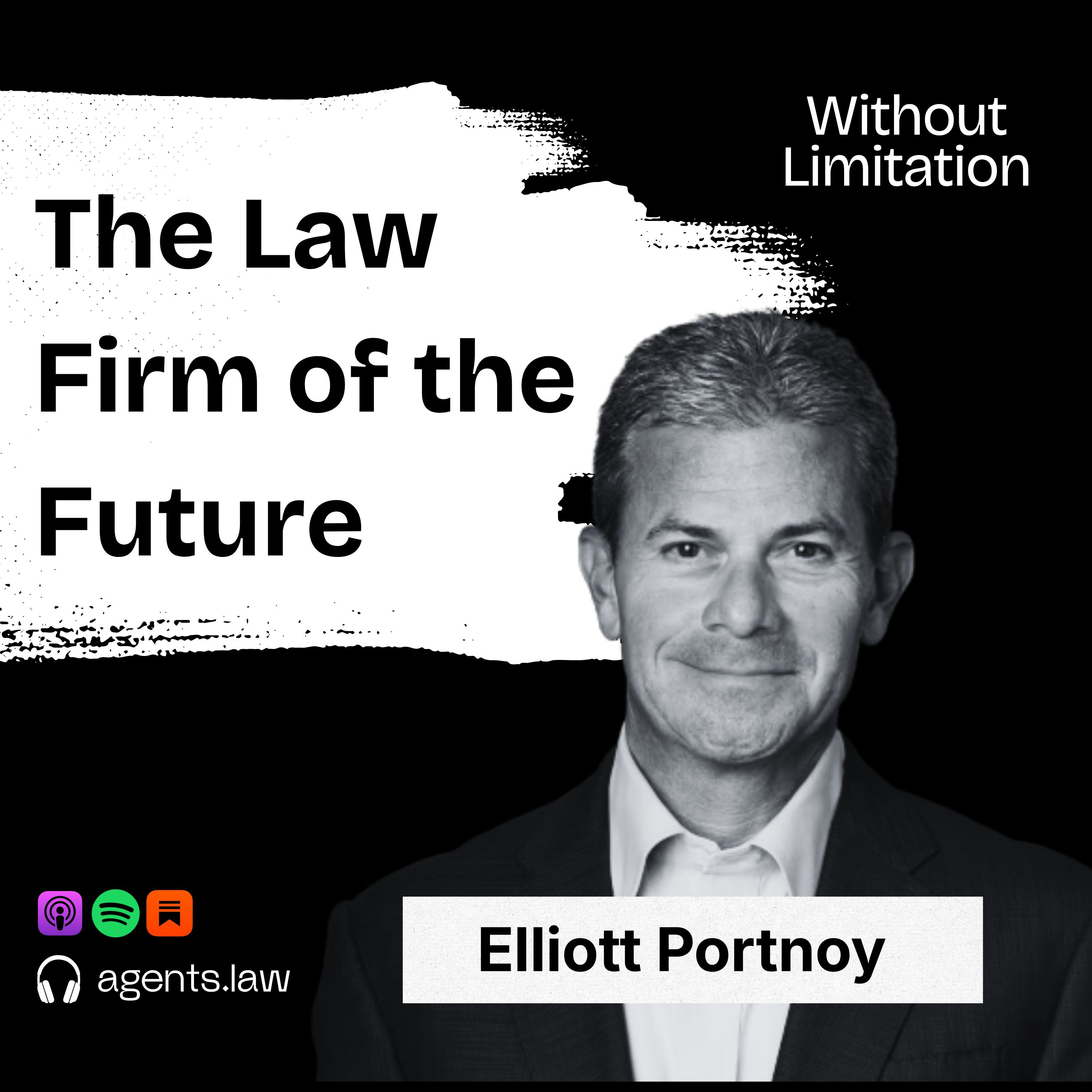
When I sit down with Elliott Portnoy, it has been just over a year since he stepped down as Founding Global CEO of Dentons, the firm he scaled from a foundation in a mid-sized US firm with no global presence and ultimately became the world’s largest law firm.
12,000 lawyers, 200+ offices, 87 countries, through 61 mergers in just over ten years. Just think about this for a moment. A merger every two months. More mergers than the rest of Big Law combined.
So, how (and why) did he do it? And if he were taking on a law firm leadership role today, would he do it all again?
Capitol Hill to the City
Elliott didn’t set out to be a lawyer. He spent years working on Capitol Hill, imagining a life in politics and policy. He eventually concluded that the law would give him what he really wanted: a practice at the intersection of politics, policy, and business. He studied as an undergraduate in the US and got his DPhil at Oxford.
His early practice was in public policy and regulatory law, and he loved it. But he’s honest that it was a different era. Washington was more bipartisan then. You could actually get things done, shape legislation, move the dial for clients. He’s grateful his practice years fell when they did. Today, he says, it’s far easier to kill things in politics than to build them.
The firm nobody expected to win
The origin story of Dentons is far more interesting than most people realise. Elliott joined Sonnenschein Nath & Rosenthal, a well-regarded US firm, but one that was, as he puts it, “absolutely indistinguishable from three or four dozen other US law firms.” It had no global presence. It had tried London once before and pulled out.
He and his team saw something others didn’t - an opening - not just to build a global practice, but to build an entirely different kind of global law firm. He calls it “a polycentric one with no dominant culture, no flag flying over the whole thing, no lawyers parachuted in from New York to do work that local partners should be doing”. The insight was radical: clients didn’t want someone who flies in from London wearing a local suit. They wanted the most elite lawyer who actually knew the market, knew the judges, knew the business community. At the time, he felt that no global law firm was genuinely “in and of the communities it served”.
The first deal, in 2010 with Denton Wilde Sapte, was not warmly received in the legal press. Elliott remembers the UK Legal Week headline vividly: it compared the combination to two drunken sailors falling into bed together. He tells me this with a smile. “It was an improbable start to what has been an extraordinarily remarkable journey.”
61 mergers in 10 years
Most law firms do a deal and then pause, sometimes for a decade, sometimes longer, while they fight out whose compensation system wins and whose culture survives. Elliott took a different view: you don’t have to choose between growth and integration. You can do both in parallel.
So they did. For most of the years he led Dentons, the firm completed more M&A than the entire rest of the legal profession combined. They built a dedicated transactions team and a separate integration team, because the skills required are genuinely different. Finding the right partner is nothing like knitting two organisations together, and conflating the two is how most firms end up stalled. At peak, they were travelling around 200 days a year. To do 60 deals, he says, “you have to kiss a lot of frogs”. There may have been 600 conversations for every 60 that completed.
What made it work was the firm’s polycentric model. Elite local firms in South Africa, India, the Philippines, across the Middle East, firms that had spent decades building client relationships and community credibility, could join Dentons and keep their identity while gaining the platform of the world’s largest law firm. Dentons became the first global law firm to combine with a leading firm in China, the first to achieve level one black economic empowerment certification in South Africa. They were the proof of concept for a genuinely different kind of global firm, and they attracted partners that no other firm could.
The three-way combination in 2013, bringing together what had become SNR Denton, Salans in Europe, and FMC in Canada, was another first. Three-way combinations simply didn’t happen in the legal profession, certainly not across continents. But Elliott and his co-architect Joe Andrew had concluded that the pace itself was part of the strategy.
There were law review articles at the time arguing you could never run a law firm with more than 5,000 lawyers. Elliott mentions this with obvious satisfaction. Those articles, he says, have had to be put in the trash heap.
Why the merger wave isn’t slowing down
The current wave of transatlantic mergers, Elliott argues, is different in character from the waves that came before. The 1990s and early 2000s were opportunistic. What’s happening now is existential.
Mid-market firms are getting squeezed from both ends. The top 25 or 30 firms are pulling away, hoovering up the most profitable work and the best talent. And at the other end, small tech-enabled firms are competing for work that used to be safe mid-market territory, because the tools now allow a lean team to do what previously required a large one. The firms caught in the middle, the ones with leaders who can see the problem but are three to five years from retirement, are the ones he worries about most. He puts it plainly: “I hear from a lot of law firm leaders who are just thinking about getting to the end of their runway and letting their successor worry about it. It’s hardly a profile in courage.”
The consequences, he thinks, will be real. Some firms will go out of business. Others will find they’ve left it too long to find a merger partner worth having. The dance music will stop, and if you’ve got no one to dance with, you may not be able to combine. US firms are arriving in London in record numbers and proving to be formidable competitors. In his view, the window for a good deal is open now but it won’t stay open forever.
If he were starting again today
I ask Elliott what he’d put on his to-do list if he were walking in as global CEO of a large law firm today. He doesn’t hesitate.
First, he’d be doubling down on global opportunity. He’s not among those who think geopolitical turbulence is a reason to retreat. He watched Bloomberg the morning we spoke covering the cascade effects of oil prices across agriculture, tech, and supply chains. There’s no going back, he says. Clients don’t retreat from global markets and they need advisors who don’t either.
Second, he’d be all-in on AI and technology - not just the narrow point solutions getting all the coverage, the plugins, the co-pilots, the contract review tools, but genuine tech enablement across the whole business. He thinks McKinsey’s estimate that 70% of legal work is automatable is probably an underestimate. The disruption, he says, is pervasive. And he suspects the billable hour will be the first major casualty, not immediately, but within a few years as the economics become impossible to ignore.
Third, he’d be shifting away from hourly billing entirely, toward alternative fee structures and success-based models that align the firm’s interests with clients.
Private equity and the AI law firm question
Elliott now spends most of his working days advising private equity firms evaluating opportunities in the legal sector, helping with everything from developing an investment thesis through to due diligence, negotiation, and board service once a deal is done. He describes it as work he loves, surrounded by smart, dynamic people who are coming at the legal industry fresh, without the assumptions (or limitations!) that insiders carry around.
He thinks the interest in law from private capital is not sudden - he reminds me that PE has been circling professional services for years, drawn by stable, recurring, profitable revenue in human capital businesses. Accountants, consultants, engineers: and law is just the next one. What changed is the regulatory environment in the US, where the MSO model now offers a workable structure. The MSO bifurcates the professional practice from the business infrastructure of the firm, allowing outside capital into the latter without touching the former. It’s a tried and tested model from healthcare and other sectors, and it’s gathering momentum fast.
By end of 2026, Elliott expects a couple of dozen US law firms to be PE-backed through this structure. By 2027 and 2028, many more. The starting point is consumer and retail-focused firms, personal injury, insurance defence, construction defect, but he expects a steady move up the value chain as investors get more comfortable with the sector and the model matures.
On the AI law firm question, he is measured. Some of the firms spinning out under that banner are genuinely embedding AI into every workflow, rethinking how legal work gets done from intake to billing. Others, he says, are doing what the dot-com era called throwing a .com on the end: branding more than transformation. The multiples being floated in bidding processes are eye-popping, he notes, though by the time due diligence is done they tend to come back to earth.
The university question
Elliott sits on the board of trustees at Syracuse University, which has forged a partnership with Anthropic to give every student and faculty member access to Claude. He sees higher education as facing exactly the same challenge as law: institutions that are leading on the front foot, and institutions that are hoping this just goes away.
It’s not going away. Faculty members, he says, may be the only group he’s encountered who are even more resistant to change than lawyers. But the institutions that embrace technology, rethink their delivery models, and position themselves as homes for lifelong learners rather than just 18 to 22 year olds, those are the ones that will thrive. The ones waiting it out are storing up a serious problem.
Law schools that don’t teach students how to use and think about AI are, he says bluntly, doing those students a disservice. They’ll arrive at law firms, public service, or wherever else they go and be fundamentally less capable of delivering value. The profession has already been disrupted. Sending people into it unprepared is a failure.
Final note
The sheer scale of his achievement at Dentons is hard to fathom, but when you meet Elliott, you can see how he did it.
He is well-prepared. He is considered and confident about where things are going and what it will take for firms to succeed. I also found him to be extremely generous with his time - before, during and after this discussion.
He’s understandably proud of what he achieved at Dentons - but what surprised me most is that he seems more energised than ever about the next chapter and his opportunity to contribute to it in both law and education.
Elliott Portnoy is just getting started.


