


Last Wednesday, more than 150 decision-makers came together in New York City for the inaugural AI Native Law Conference. I was fortunate to co-chair the event alongside Patrick DiDomenico, founder of LegalTech Connect.
We had founders building new law firms, leaders of established firms, in-house lawyers, technologists and investors in the same room. They agreed on plenty. They also disagreed on some key questions about where the industry is going. And that made for a much more interesting day!
If you couldn’t make it to New York, here are my main takeaways.

Marketing hype or a real category?
I opened the day with findings from the AI Firm Index, the directory I created earlier this year, which now covers more than 60 firms.
The question I wanted to explore was whether “AI-native” is just marketing hype, or whether there is something fundamentally different about how these firms operate.
We have been here before. If you were a CEO in 2001, you could increase the value of your company by 74% simply by adding a .com after your company name - and it didn’t even matter whether you had an e-commerce business. (The original research is a useful reminder of how powerful a label can become.)
So, are we seeing the same thing, with law firms calling themselves “AI-native”? Are we looking at a Pets.com (a traditional business that bolted on a new technology and went insolvent less than a year after IPO) or an Amazon.com (a company that reimagined retail around the new technology)?

I also went further back in time - to the electrification of factories. You’ve probably heard this one: when electricity arrived, most factories simply replaced the steam motor with an electrical one, without redesigning the factory around what the new technology made possible. Paul David’s account of factory electrification describes why those changes took time. As a result, the initial gains were very modest. It wasn’t until later that factories reimagined delivery around the new technology.
That is the question I think law firm leaders should be asking themselves. Are we retrofitting, or are we reimagining?
The survey findings I presented suggest that something distinctive is emerging. Among the firms I surveyed:
86% earn most of their revenue from fixed fees, subscriptions or products.
68% let clients interact directly with AI or self-serve part of the work. (When I speak to law firms, I often hear how clients are sending them AI-generated work product or comments, and that this is actually slowing things down. It seems that the firms on the Index are leaning into this and providing a channel for it, rather than fighting it.)
93% run AI first on every matter, before a lawyer begins work on it. (This is important: AI is used not just as an assistant or Copilot to an individual lawyer, but as a fixed step in the production line before it reaches the lawyer.)
82% have a dedicated AI, product or engineering role. (A meaningful number as a percentage of the overall headcounts of these firms, which tend to be startups or scale-ups.)
I also shared that 71% of firms on the Index are bootstrapped. This goes against the common view that AI-native firms are VC- or PE-backed. The capital required to launch a law firm is perhaps lower than it has ever been.
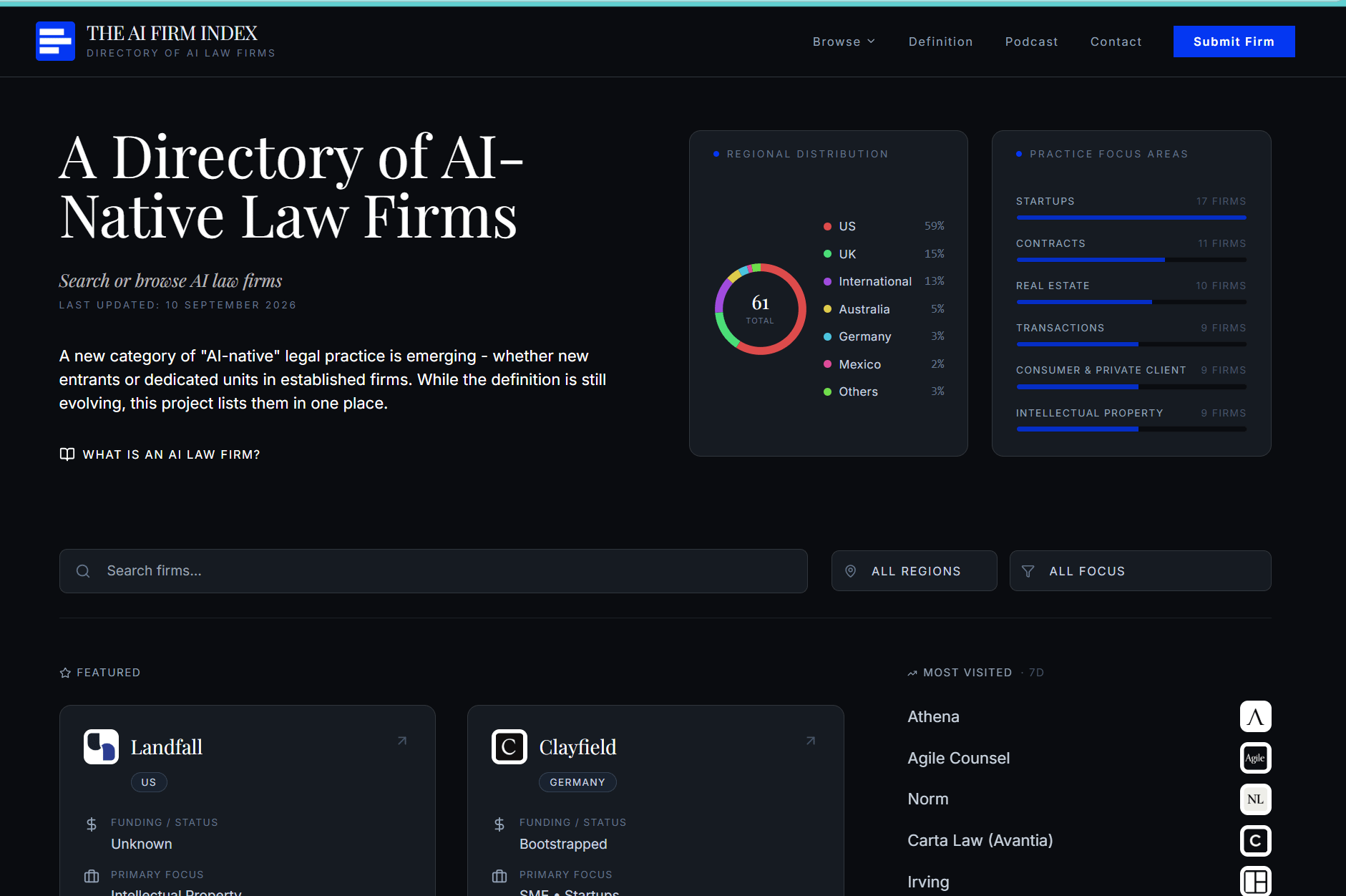
Bottom line: I am not too focused on the term we use. Richard Tromans does a thoughtful job making the case for “NewMods”, which I think is helpful in emphasising that it’s a new operating model, more than just the technology, that defines these firms. Equally, I’m conscious that “AI-native” is used in other industries beyond legal - from accounting to recruitment to VC, which may help it to stick.
Either way, I do believe this is becoming a meaningful category worth tracking. Sure, there are some ‘Pets.com’s out there - firms perhaps leaning into the category before they have really changed how they work - but the data (and discussion that followed) shows there are already firms doing things very differently.
Start with the data
Mark Smolik, Chief Legal Officer at DHL Supply Chain Americas, made the case for starting with the foundations - in particular, the data. His analogy of a real estate construction project was a good one: a building project depends on having the right materials and plans in place before the work begins.
The same applies to a law firm or law department trying to make use of AI. What information do you have? How usable is it? Do you understand the work well enough to know where technology will help?
For me, this also connects directly to pricing. If you want to commit to a fixed fee and a turnaround time, you need to understand how the work gets done and where the uncertainty sits. That requires operational discipline as well as capable AI.
In my experience running these sessions with customers at Lupl, this usually involves sitting around a white board, and mapping out the work, from intake to close and beyond.
The client conversation is still at an early stage
The in-house panel brought together Laurie Basch of McKinsey & Company, Elizabeth Spector Louden, formerly of Etsy and now founder of Spector Louden Law, and Erica Swainson of Salesforce, moderated by Ken Crutchfield.
One of my biggest takeaways was how early the conversation between firms and clients about AI still is. Law departments see the law firm press releases about AI. They now want to understand what those announcements mean for the service they actually receive.
If something used to take ten hours and now takes two, who benefits from the saving? Does the client pay less? Does the firm improve its margin? Does the client get a better answer, or a faster one, or both?
Clients are becoming more assertive in asking these questions. The panelists shared that they are increasingly considering AI-native firms and alternative legal service providers in RFPs.
That could become a significant source of pressure and a reason for established firms to rethink delivery.
How do you design and structure an AI-native firm?
Jenn McCarron of Contracts.ai led the discussion and was a fantastic bridge between the “law firm” and the “law department” perspectives at the event, having led legal ops at Netflix, amongst others, and launched Contracts.ai. As law firms begin to rethink how they operate, I think we should spend more time listening to the perspectives of law department legal ops leaders like Jenn, as they have been rethinking how legal services should be delivered for many years.
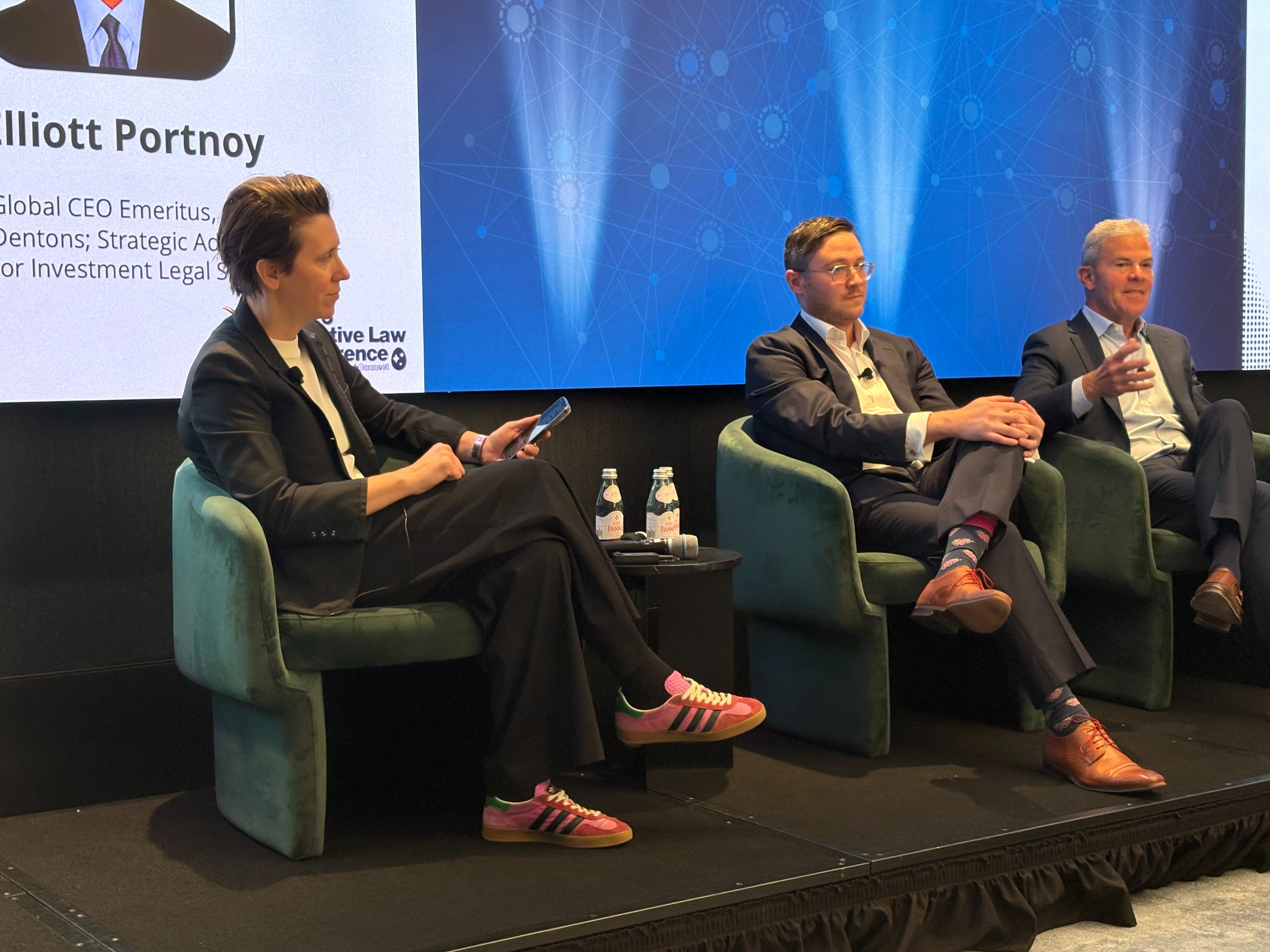
Elliott Portnoy, Founding CEO of Dentons, brought the unique experience of having built the world’s largest law firm, and is now advising PE on investments in the legal sector. (If you want to hear Elliott’s story, check out our recent interview - one of my favourite podcast episodes so far.)
Elliott’s view is that while large firms probably cannot pivot to be fully “AI-native”, they have a clear opportunity to build captive AI-native business units. This aligns with what I call the multi-channel law firm. Firms will offer bespoke advice alongside productised services, with different delivery methods and economics. Clients will have a choice appropriate to the work they need done. Making that work would require decisions about ownership of the service, partner incentives and how work gets routed. I also expect more new firms and more partners spinning out practices of their own.
Josh Porte of Holland & Knight has advised on many of the most notable MSO and AI-native launches in recent times. Josh shared that his team has seen a 5x increase in engagements involving management services organisations, or MSOs (the back office structures that support law firms and that, unlike US law firms, can take external investment). For the US in particular, the regulatory landscape still has a number of restrictions that investors and operators need to be aware of, and Holland & Knight’s law firm structure and regulation resource is the best overview I have seen.
Inside an AI-native law firm
Michael Showalter gave a practical example of how an AI-native litigation practice operates. He has built Showalter PLLC around an experienced litigation lawyer working with AI, with a very different cost structure from a conventionally staffed practice.
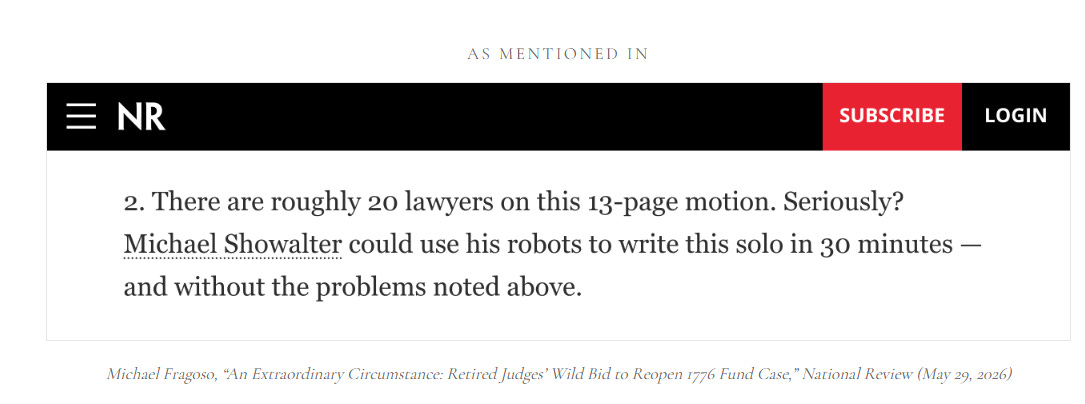
His firm’s published commitment is striking: a price at half any standard-rate quote from a Chambers-ranked practice for litigation work. The firm says it uses flat fees and verifies every citation against primary sources.
Michael’s practical demonstration with Otto Zastrow of Midpage, the AI-native research platform, brought the research process to life. Michael and Otto showed how a firm can complete research tasks and reduce the risk of hallucinations without leaving Claude, Copilot, Codex or Perplexity.
Can AI-native firms compete with traditional firms?
This was my favourite panel of the day. Avi Gesser of Debevoise & Plimpton expertly moderated a discussion with Liz Paisner of General Legal and Sanjay Kamlani of FairPlay Law.
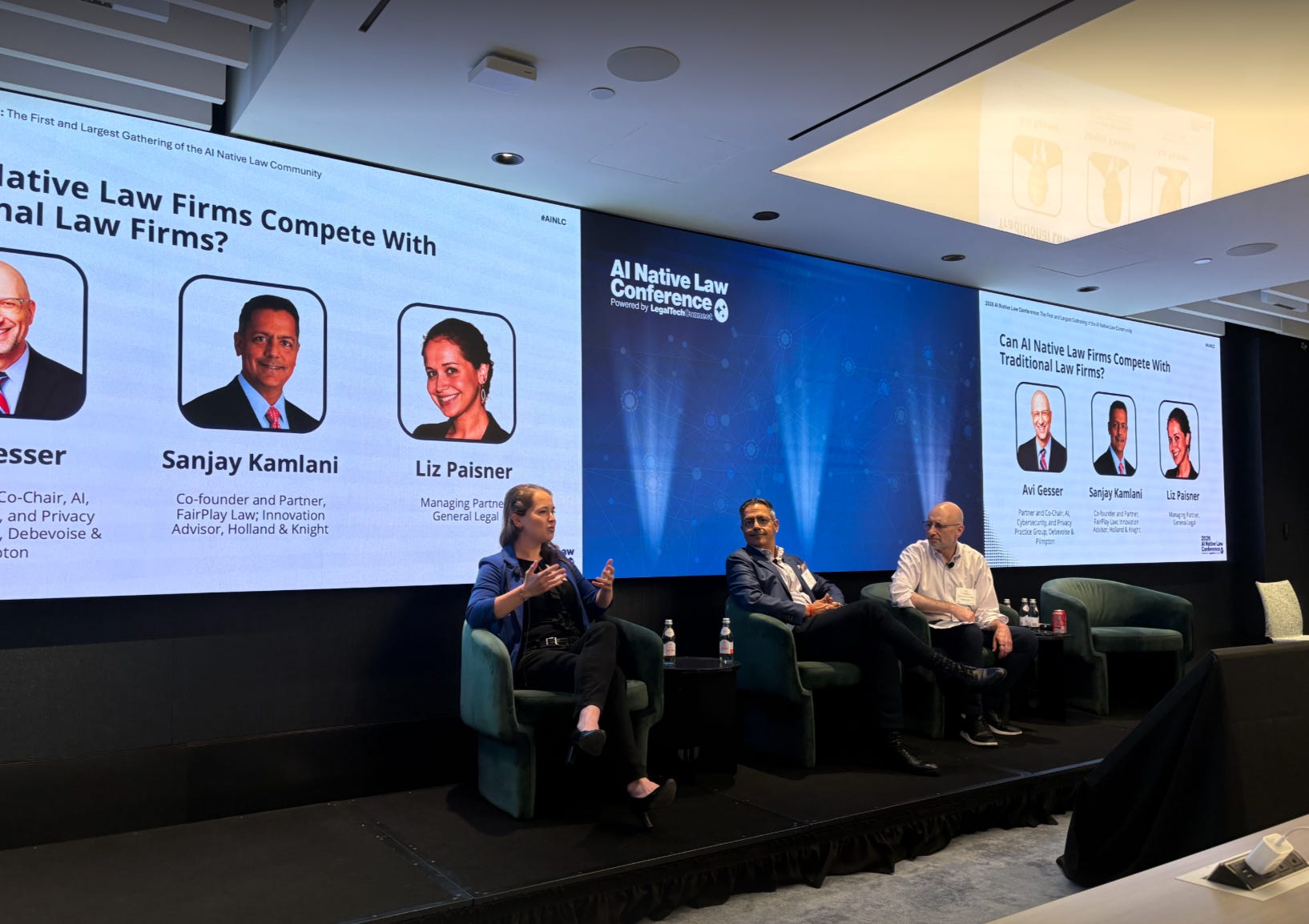
At industry events, I sometimes struggle with panels where everyone furiously agrees with everyone else. Here, there was healthy, friendly disagreement. Three differences stood out:
First, the ability to change. The established-firm position was that a business-model pivot is not yet necessary, and that firms can make the change successfully when the time comes. The AI-native bet is that incumbent structures will make that change too difficult, or too slow.
Second, the value of data and brand. Larger firms see substantial protection in their institutional knowledge and reputation. AI-native firms question how durable those advantages will prove as technology improves and clients gain experience with new providers.
Third, resilience through an economic cycle. Large firms can point to the breadth of their practices: when some areas slow, others become busier. New entrants are betting either that they can broaden their offering over time or that their chosen work will remain resilient.
These are competing hypotheses. We will learn a great deal by watching where clients send work over the next few years.
There was one point of agreement: law will remain, above all, a relationship business. Whatever happens to the production of legal work, clients will still care deeply about whom they trust with it.
The Legal AI Value Stack
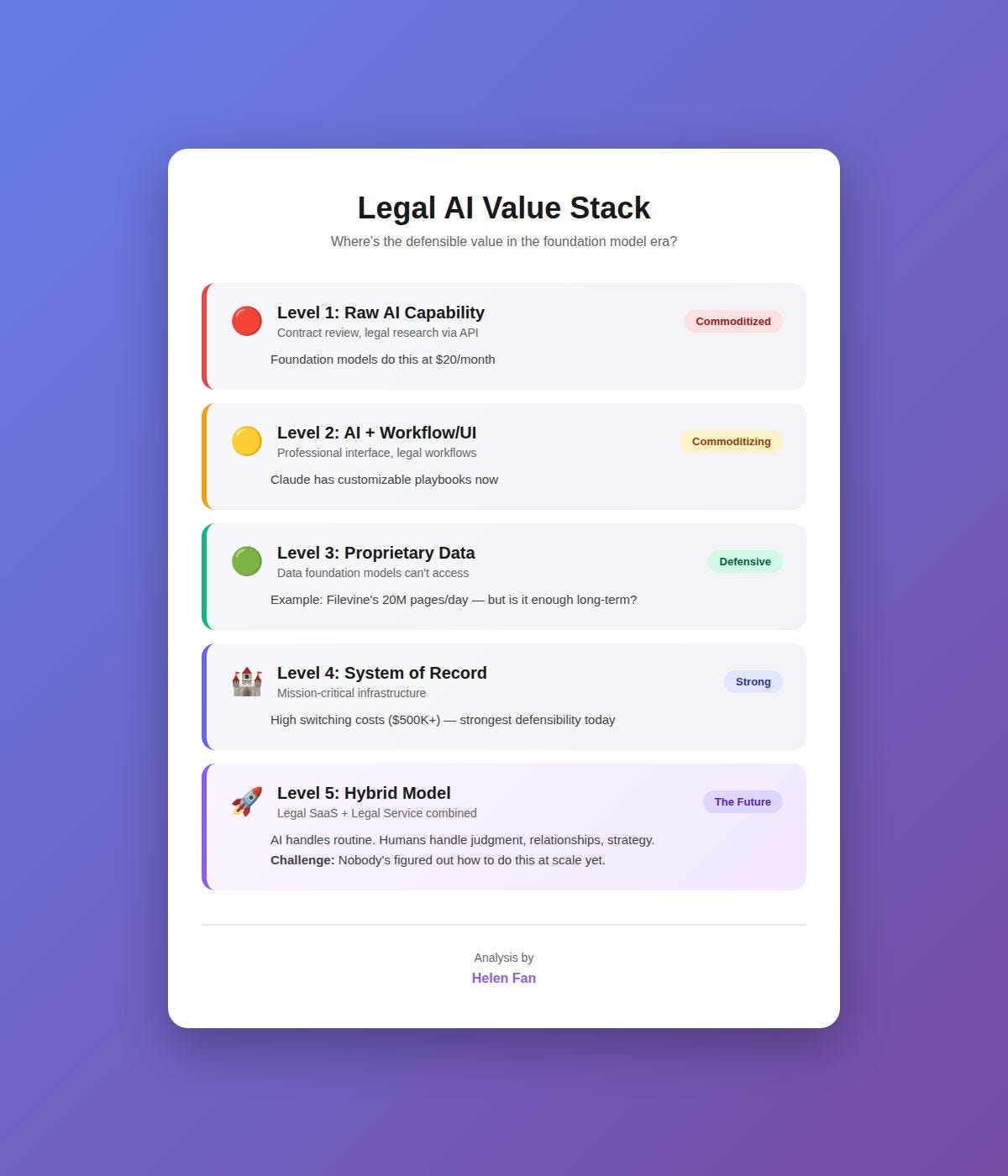
Helen Fan, Chief AI Officer at MagStone Law and founder of Helen’s Legal AI Lab, brought another perspective with her Legal AI Value Stack, which she developed as part of an intensive 100-day experiment building with AI agents.
Her published framework describes five levels of AI capability so that firms can benchmark themselves and their offerings: raw AI capability, AI embedded in workflows, proprietary data, systems of record, and a hybrid model combining technology with legal service delivery.
Build, buy, or blow it up?
Rob Saccone and Jeffrey Sharer provided a useful way to organise the choices facing firms. They framed the options facing law firms as:
Buy: add tools to existing services and ways of working.
Build: redesign a service within the existing firm model.
Blow it up: start with a clean slate and reconsider the product and business model together.
Each implies a different level of commitment. A firm can buy excellent technology and still make only modest changes to how it serves clients. Building a service raises further questions about investment, ongoing ownership and whether the economics justify the effort.
My takeaway was to start from the client’s “job to be done” and work back. Sometimes it’s a build. Sometimes it’s a buy. And sometimes it’s a blow it up. And be prepared to experiment with all three.
Where will the work go?
Ryan Walker, who was CTO at Casetext (sold to TR for $600m) before co-founding General Legal, looked at what happens as legal services become less expensive and more readily available.
Two predictions jumped out: Ryan believes that more work currently handled by traditional firms will move to AI-native firms, and more corporate overflow work will route to them too.
I also think we should watch for demand that has previously gone unmet. When a service becomes affordable enough, clients may seek advice on matters they would previously have handled without a lawyer. That would expand the market as well as redistribute existing work.
Outside money, inside pressure
The funding discussion featured David Perla of Burford Capital, Lee Minkoff of Renovus Capital Partners and Richard Perris of Covenant.
The pace of private investment in accounting provided a reference point for what could happen in law. There was a strong view that legal could look substantially different within five years. One of the panelists told us that 30/50 of the top accounting firms have now received external investment - and it was closer to zero, five years ago. They expect legal to go the same way.
The discussion reinforced Joshua’s earlier observation about MSO activity (a 5x increase). Much more appears to be happening than the public announcements alone would suggest.
One possibility raised was that established firms or MSO-backed platforms could acquire AI-native businesses, adding a delivery capability with attractive margins. That fits with the multi-channel model I described earlier.
There was also a useful distinction between a promising AI-native firm and a business ready for private equity. Many new firms are still too early to fit the latter comfortably. The opportunity in MSOs may be more immediate, while individual AI-native practices prove that their economics and delivery methods can scale.
We ended with an open forum led by Jen Berrent, CEO and co-founder of Covenant, and Rick Merrill, founder of Merrill. The conversation overflowed into the drinks that followed, which is always a good sign at these events!
Will we still be using the AI-native label?
Honestly, I don’t know. I think there is enough evidence now to take all these firms seriously as a distinct development in legal services. There are observable differences in how many of them price work, organise delivery and build their teams. There are clients willing to try them, and experienced lawyers prepared to build them.
Whether “AI-native” remains the label will depend on how useful people find it. I will be watching the firms themselves: what clients buy from them, whether they deliver on their promises, and how their businesses develop.
My final reflections
I ended the day reminding everyone that we are still early. It has only been three and a half years since ChatGPT. And three and a half years ago, AI was really bad. (This is one reason I built the AI Time Machine - to reflect on how much the technology alone has changed in such a short period.)
Business model change always lags technology change. Electricity has only just arrived in factories, and it will take time to reimagine the business model around what this new technology makes possible. With plenty of events focused on the technology, I was delighted to be part of an event focused on the business model.
I can’t wait to see how things have changed by 2027.
Thank you to Patrick, our speakers and everyone who joined us in New York.