


Yesterday, Legora announced that it is moving its most capable product to usage-based pricing. This has been coming for a while, and Legora’s announcement will be the first of many.
I think a lot of firms are underestimating the impact of this shift. It goes well beyond licence fees and software procurement, with potentially profound implications for the pricing and delivery of legal work and for the law firm business model.
So, I have pulled together a short guide on what is driving the shift, how firms should respond, and what they might want to put in place before usage-based pricing becomes the default.
The TLDR is to start treating this as an operating model change.
1. Why this is happening
There are two key reasons behind this shift.
Compute is expensive and agents are hungry
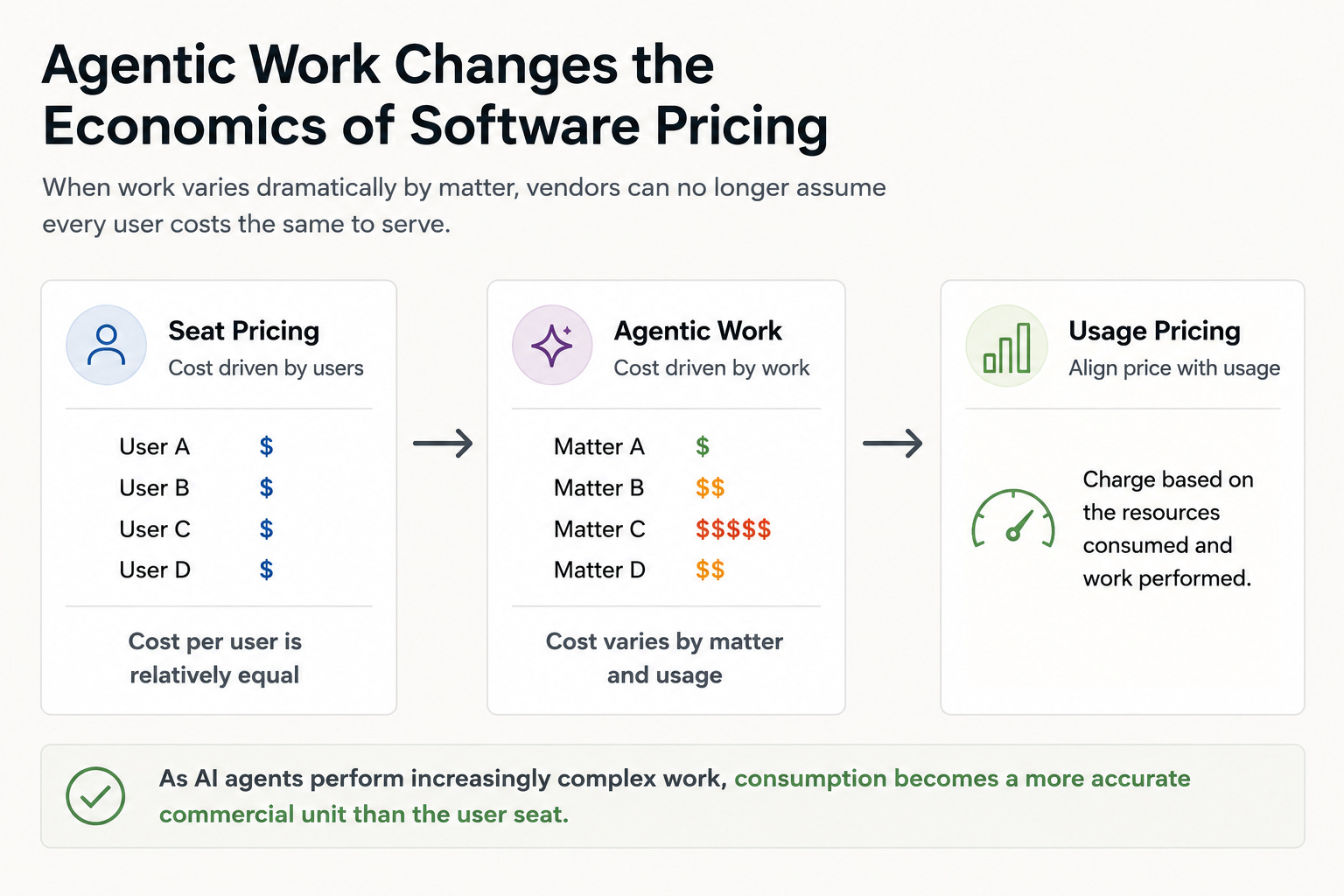
A long-running agent that plans, executes, and checks its own work can burn a hundred times the compute of a quick query. The spend also swings wildly between matters and users.
A flat seat price, which is how most legal AI vendors price today, assumes every user costs about the same to serve. Agents break that assumption, so the vendor either eats the variance or passes it on. They are going to pass it on.
If you’re interested in what is happening in the physical supply chain and why a Compute Crunch may be happening, I wrote about this earlier in the year.
Valuations depend on this
We all know the legal AI valuations are in the billions. Vendors cannot get to those valuations by pricing on seat count alone, because there are only so many lawyers in the building.
They get there by betting that law is a trillion-dollar industry, of which $X, let’s say $400b for the sake of argument, is people cost. When automation arrives in an industry, some percentage of that cost of production becomes software spend.
I don’t really subscribe to the eye rolling about legal AI valuations. When the numbers are approached this way, the logic is at least plausible. That still leaves plenty of execution risk, but I do not think it is a wildly impossible summit.
Question the marketing
The marketing around the announcement says this is about moving to outcomes. I’m not sure about that, at least for now. Usage-based pricing is quite literally paying for something based on inputs, not outcomes. It may force firms to price more around outcomes, as I’ll come on to below, but at its core this is a very simple consumption-based model.
2. How firms should respond
I actually think this is a bigger deal than most firms realise. Usage pricing has the potential to reshape roles, internal politics, training, and the build-versus-buy debate. Here are some initial thoughts on how firms may need to respond.
Build a TokenOps function
Will firms outsource optimisation of token usage and model orchestration to a vendor, or will they bring it in house? I think the smart firms will have an internal function that owns the economics of AI use.
The reason is about incentives. The vendor usually profits from every token the agent burns, so it has little reason to tune the agent for the firm’s cost rather than its own revenue and margin. Inside law firms, I think we may see the emergence of a TokenOps or AI Ops function, effectively the token equivalent of the FinOps discipline cloud buyers built to stop AWS and Azure bills running away.
How much this matters depends on the legal task, firm and practice group. For simple, structured tasks such as routine contract review, token cost may be a rounding error against the human cost it displaces. It matters much more at higher volumes, or on long-running agentic work across a whole matter, where cost per run climbs and the variance between matters starts to affect margin.
A TokenOps function would own model routing, independent metering, token budgets, and the right-sizing of agent workflows.
Right now, this capability probably sits somewhere between IT, Innovation and LPM/Pricing. No one really owns it yet, and that will need to change.
Training lawyers to use AI efficiently
TokenOps should have a user-facing side as well as a technical one. Firms need to train lawyers to use AI appropriately, including deciding whether AI is the right solution for a particular task in the first place, and how to use it for a given task.
A lot of AI waste will come from poor task selection. Some work should be automated, some should be supported by AI, and some should still be done by a human because the setup, supervision, review burden or token cost outweighs the benefit.
This means moving beyond generic training. I’m not suggesting we spend hours training lawyers on AI economics right now but we can at least start with key principles, including understanding which tasks are worth sending to AI, how much context is enough, when a cheaper model is likely to be sufficient, and when a process/workflow should be reused rather than rebuilt.
The aim is to give lawyers enough commercial and operational literacy to avoid treating AI as free capacity, which is where we’re at today.
LPM and pricing move to the front line
Existing functions will change, too. Legal Project Management and Pricing teams in law firms have been under-resourced for years, but once the cost of production is variable and visible, and potentially baked directly into pricing, their work becomes much more strategic.
These teams will work alongside TokenOps. TokenOps controls the cost, while LPM/Pricing decides what to do with it and how best to manage the means of production to deliver the client’s outcome.
I think firms should invest in these teams now and stop thinking of them as a support function.
The rise of token politics
This might get political. Expect questions like who gets how much AI allocation - partners or associates, by practice group, by matter, or as a percentage of someone’s billing?
Heavy AI use has recently been celebrated, but it might also be seen as inefficiency, depending on who is telling the story.
A per-head budget is simple but may be a blunt instrument. A central pool with approval gates controls spend but might be unwieldy. A per-matter budget funded by the matter is the cleanest, because it ties consumption to the work that justifies it, though it also forces the client pass-through question to the surface and requires matter-level decision-making or approvals. Firms may need to run a few experiments here and see what works.
Insourcing and open source
Under usage pricing, firms are paying a vendor’s margin on top of raw model cost, and at scale that margin will come into question. The options run from buying everything off a vendor, to going direct to model providers, to building an internal orchestration layer and running open-weight models for the high-volume commoditised work.
It’s worth remembering that most legal work doesn’t need the most expensive model. We could have a decade of innovation with the models that came out last year. Extraction, classification, summarisation, and first-pass review run well on cheaper or open models given good orchestration, playbooks, and quality control.
With this in mind, larger firms with scale and engineering capacity will be tempted to vertically integrate and own more of their cost of production.
3. Let’s talk about pricing
Firms have basically three options for responding to variable AI costs.
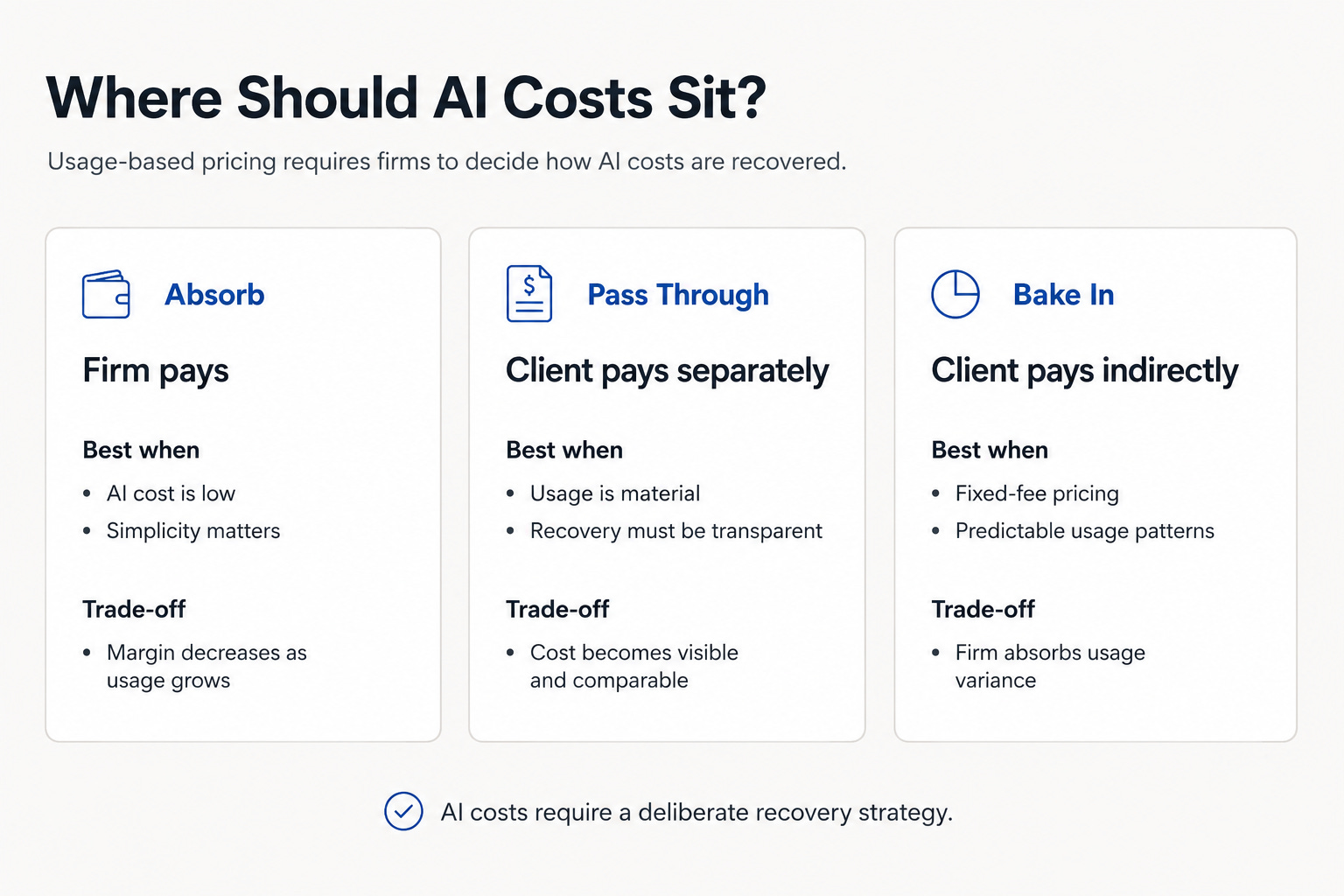
Absorb it
Absorbing the cost in overhead and rates keeps the client conversation simple. The problem is that it compresses margin as usage grows, especially if agentic work becomes part of ordinary delivery rather than a controlled experiment.
Pass it through
Recovering the cost as an explicit matter-level disbursement is easier to support where tools provide matter-level tracking, and this is one reason Legora introduced a matter dashboard. It also invites clients to compare the firm’s number with the cost of running the tool themselves. We’ve seen all this before. Back in the day, firms marked up online research and photocopying aggressively - clients objected, and those charges ended up back in the firm’s overhead.
Bake it into fixed fees
Baking the cost into fixed fees may be attractive in some ways because it gives clients certainty. But the firm then carries the same usage variance risk the vendor has just moved away from, so scoping and matter management become much more important.
Before choosing a policy, firms should check their engagement letters and clients’ outside counsel guidelines. Many already restrict technology and research disbursements and expect this to become a new aspect of annual rate negotiations and panel reviews.
4. What about clients?
A firm cannot make money marking up compute that the general counsel can buy at the same price.
The more defensible margin is in judgment, accountability, bearing risk and taking ownership. Firms need to work out which side of that line each piece of work sits on, because clients are doing the same calculation.
In practice, relationship partners should know which parts of each client’s work to defend on value and which to concede.
5. An opening for AI natives?
New entrants do not carry seat economics, the partnership pyramid or the politics.
AI-native legal businesses can build around consumption from day one, route models aggressively, run on thin compute margins, and potentially price below incumbents.
They will go after the middle: the bounded, repeatable, agentic work. Incumbents will keep the top, the bet-the-company judgment, but risk losing the layer beneath it.
What to consider in H2 2026
Putting it all together, I think there are a number of things firms could be doing now to prepare for this shift, even if they are still subject to seat-based licensing under their current contracts.
Appoint someone to TokenOps. This could be an external hire (look at those coming from software engineering and DevOps/FinOps) or by retraining someone inside the firm.
Train lawyers on task selection. Firms need users to understand when AI is worth using, when it is overkill, and how to avoid unnecessary context, retries and review loops. It’s early for this and there’s plenty of other training to do, but I’d suggest starting to work it in at least at a principles level.
Resource LPM and pricing now. These teams are under-resourced. They will directly drive bottom line and need more support.
Speak to clients. This change is affecting all of us at once. The best client relationships come from open, honest conversations and this is no different.
Consider buy and build. Often this gets conflated into picking one path or the other. I can see a future in which firms own some AI infrastructure in-house, and they partner with vendors for others. If you don’t have any AI capabilities in-house, you’re completely dependent on a vendor who’s interests may not be 100% aligned with yours.
I think this will take some time to play out, but I do think this is a more fundamental operating model shift than most appreciate. Firms have an opportunity to get ahead of this now.
Hi Matt! I hope you're doing well. Interesting read. I think the most important point here is managing token costs and deciding between buy and build. With open-source models becoming cheaper and increasingly used in the recent Fable 5 and Mythos 5 repeal, law firms could fine-tune and train them. Furthermore, Chinese open-source models such as GLM 5.2 are becoming replacements for ChatGPT, Claude, and Gemini.
Consumption-based pricing is a transition phase. Legal AI startups will shift to outcome-based pricing based on the number of contracts reviewed or drafted,/drafted or the number of term sheets reviewed, etc. This is something I've written on as well for the Indian LegalTech Network (ILTN).
https://www.indianlegaltech.net/post/from-seats-to-outcomes-the-new-economics-of-legal-ai
I write a blog titled "The LegalTech Thesis" wherein I analyze startups, trends, and opportunities in the space. Would love to know your thoughts!
https://harshithviswanath.substack.com/