


I’m spending a growing amount of time these days consulting for law firms on business and operating model change. One topic that comes up a lot is “Should we launch a product?”
Often, a partner has an idea for a software product - perhaps a client portal, a horizon scanning dashboard, or an AI solution designed for their practice area.
Sometimes, they don’t mean a product in the sense of software, but a productised service, with a fixed scope, fee, timeline and (maybe) outcome.
It’s coming up so much now, that I decided to write down the process I’m following. After a quick look at the differences and pros/cons of products vs. productised services, I focus on:
Whether your firm should launch a productised service
Why doing so might involve difficult decisions and how to navigate them
My process for designing and launching a productised service.
As always, I welcome your feedback.
First, some context: Law firms are about to go multi-channel
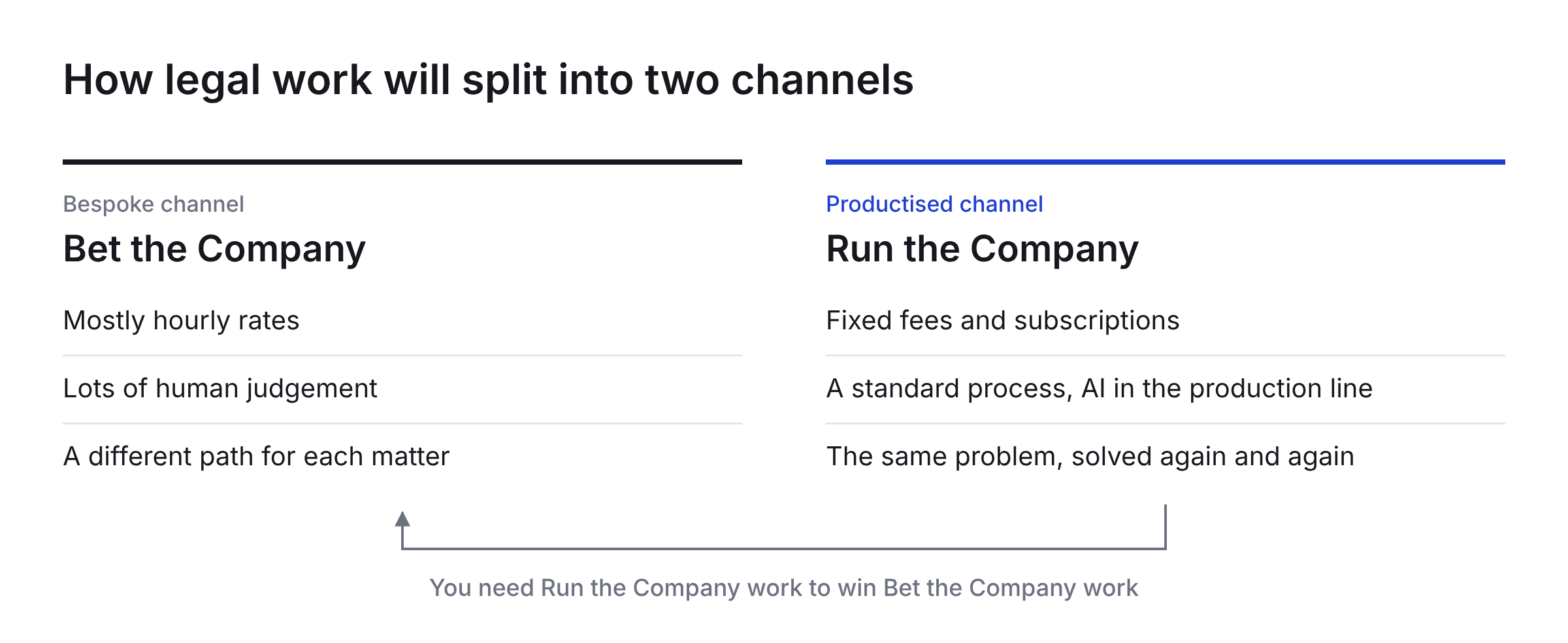
This time last year, I wrote about the idea of the Multi-Channel Law Firm. Long story short, I think legal work will split into two channels:
Bespoke: Bet the Company work will continue to flow down the bespoke, artisan channel. Mostly hourly rates, lots of human judgement, a different path for each matter.
Productised: Run the Company work will flow down a productised channel. Think: AI integrated into the production line of work.
Some firms will try to protect the bespoke channel as much as possible. One problem they may face is that you often need to do the Run the Company work in order to win the Bet the Company work.
Others will lean more heavily into the productised channel. Many of the new AI-native entrants will only support the productised channel.
(Side note: David Maister’s split in Managing the Professional Service Firm is still useful here. He grouped professional work into “brains” (novel, high-stakes problems), “grey hair” (problems the firm has seen before, where experience matters) and “procedure” (well understood work where efficient process is what the client is paying for). Productisation is mostly in the third group.)
What is the difference between a product and a productised service?
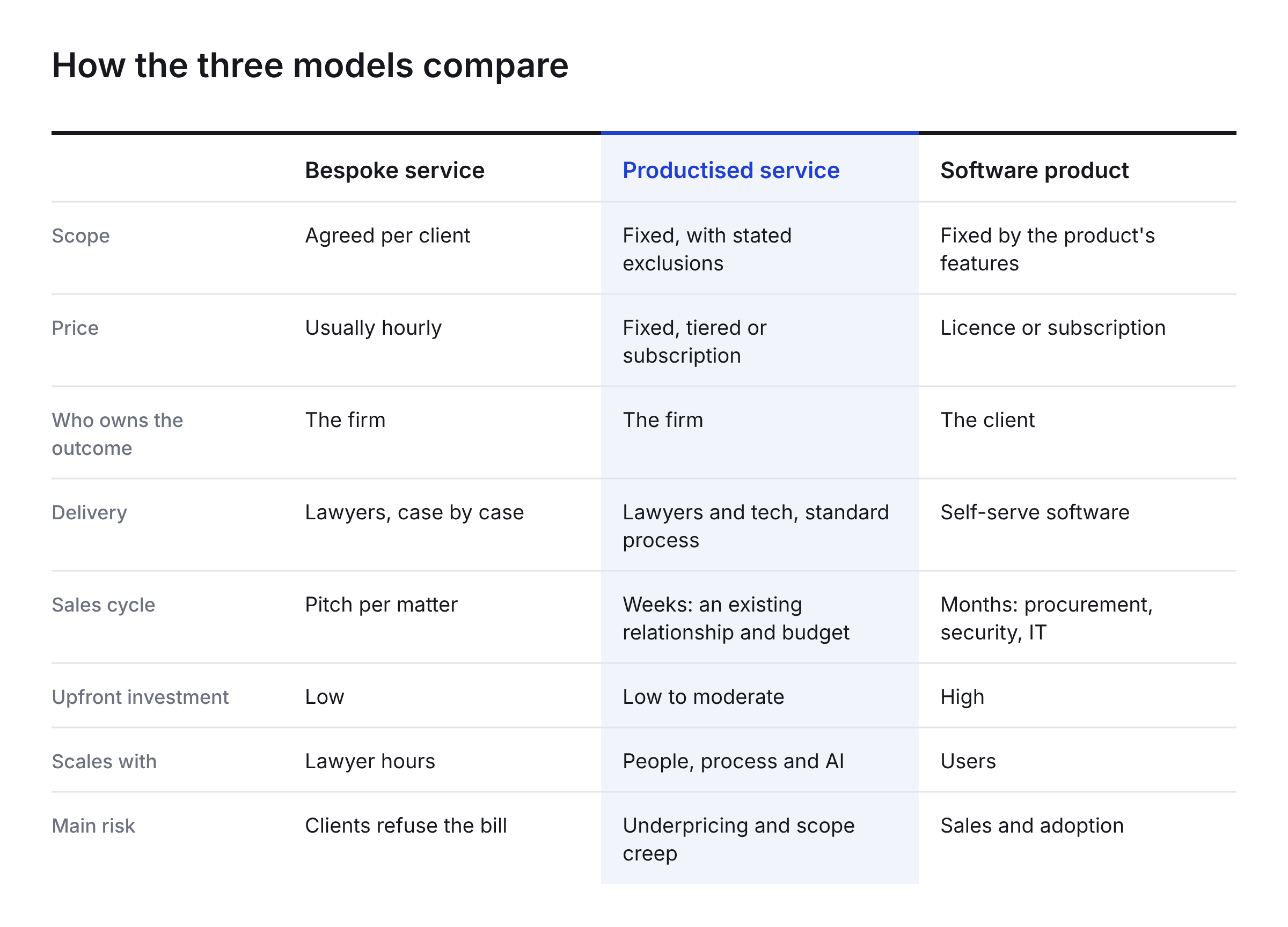
Products: giving the client a tool to solve a problem
“Products” usually means software. Common examples are:
Portals
Horizon scanning tools
Subscription knowledge and compliance databases
Self-serve document generators
AI tools licensed to clients
With a software product, firms are mostly providing a tool and asking their client to use that tool to solve their problem.
Productised service: owning the problem
A productised service is different. In my mind, it’s a combination of people, process and technology to own and solve the problem.
What the client gets. A defined deliverable.
How it is delivered. A standard process, with set decision points.
How long it takes. A target timeline or service level.
What it costs. A fixed price, a menu of prices or a subscription, decided before the work starts.
Examples include a fixed-price trademark watch service, a Series A “in a box”, a monthly contract review service with a turnaround commitment, or a regulatory health check at a set price per entity.
Productised service is usually the best place to start
Back to the partner with the idea for a portal. Why do I usually steer them towards a productised service in the first instance? Because firms will often find productised services easier to sell:
It is an extension of what they already do. Same clients, same lawyers, same relationship partners, often the same engagement letter. A software product requires the firm to become a different kind of business.
Shorter sales cycles. A General Counsel can buy a fixed-fee service from a firm already on the panel, often from an existing budget. Software goes through procurement, information security reviews, IT integration, training and a renewal decision every year.
It leans into the firm’s advantage. Law firms are regulated and insured. They can stand behind the work and own the outcome, which a software product does not do. Launch an AI tool and you compete with Harvey, which raised at a $15.5bn valuation in September, and with every other well-funded vendor shipping new features each month.
Firms know how to market and sell services. They have BD teams, client programmes and pitch processes built for services. Selling software needs a different machine: product marketing, demos, trials, onboarding, AEs, customer success.
The economics fit the partnership. Software needs heavy upfront investment (albeit, less these days given agentic engineering tools), plus ongoing spend on maintenance, security and a product team, with returns years later. A partnership that distributes its profits every year finds that hard to fund. A productised service can make money from the first matter.
Clients expect to pay for it. Clients are used to paying law firms for legal work. Many expect a firm’s software to come free as part of the relationship.
This doesn’t mean products are a bad idea, at all. When they work, the cost of serving one more client is close to zero and the asset has significant value in its own right. There will still be cases where it makes sense for law firms to build software and maybe I’ll cover that in another post.
So: Should your firm launch a productised service?
For some of your work, I think yes: the work that sits in the Run the Company channel. By the way, this might be productising an entire matter type, or simply a workstream within a larger matter. For example: maybe diligence gets productised, while deal management and negotiation do not.
Why clients want it
Ask a General Counsel what frustrates them about buying legal services and you tend to hear the same things. They don’t know what it will cost. They don’t know how long it will take. They can’t compare one firm with another. And they suspect that when the firm gets faster, they don’t see the benefit.
A productised service answers each of those. The price is known. The timeline is known. The scope is written down, so it is comparable. And the client buys something more specific in terms of outcome.
What’s in it for firms
Margin from efficiency. Under the billable hour, every hour AI saves is revenue lost. Under a fixed price, the saving goes to margin. This is the main reason the topic has moved from the innovation team to the management committee.
Keeping the work that feeds the rest of the firm. Run the Company work is often how a firm wins and keeps a client. It leads to work for other practice groups, and it is why the client calls when the Bet the Company matter arrives. As clients look for cheaper ways to buy routine work, a productised service is the best way to keep it, rather than lose it (and the relationship) to an AI-native firm.
Predictable revenue. Subscriptions and repeat packages smooth out the peaks and troughs of matter-based work.
Better data. When you run the same process many times, you learn where the time really goes, and you can price the next version better.
Enterprise value. A repeatable, documented offer is worth more to a buyer or investor than a book of relationships.
Why is it hard?
If productising makes so much sense, why haven’t more firms done it? Because for most firms this is an iPhone and iPod moment.
In January 2007, Apple launched the iPhone, a phone with an iPod built in. At the time the iPod was Apple’s biggest business: as recently as 2006 it brought in more than half of Apple’s revenue. Asked whether the iPhone would cannibalise iPod sales, Steve Jobs told staff that if anyone was going to do it, it had better be Apple. By mid-2009 the iPod’s share of revenue had fallen below 18%, and the iPhone had overtaken it. (Fortune)
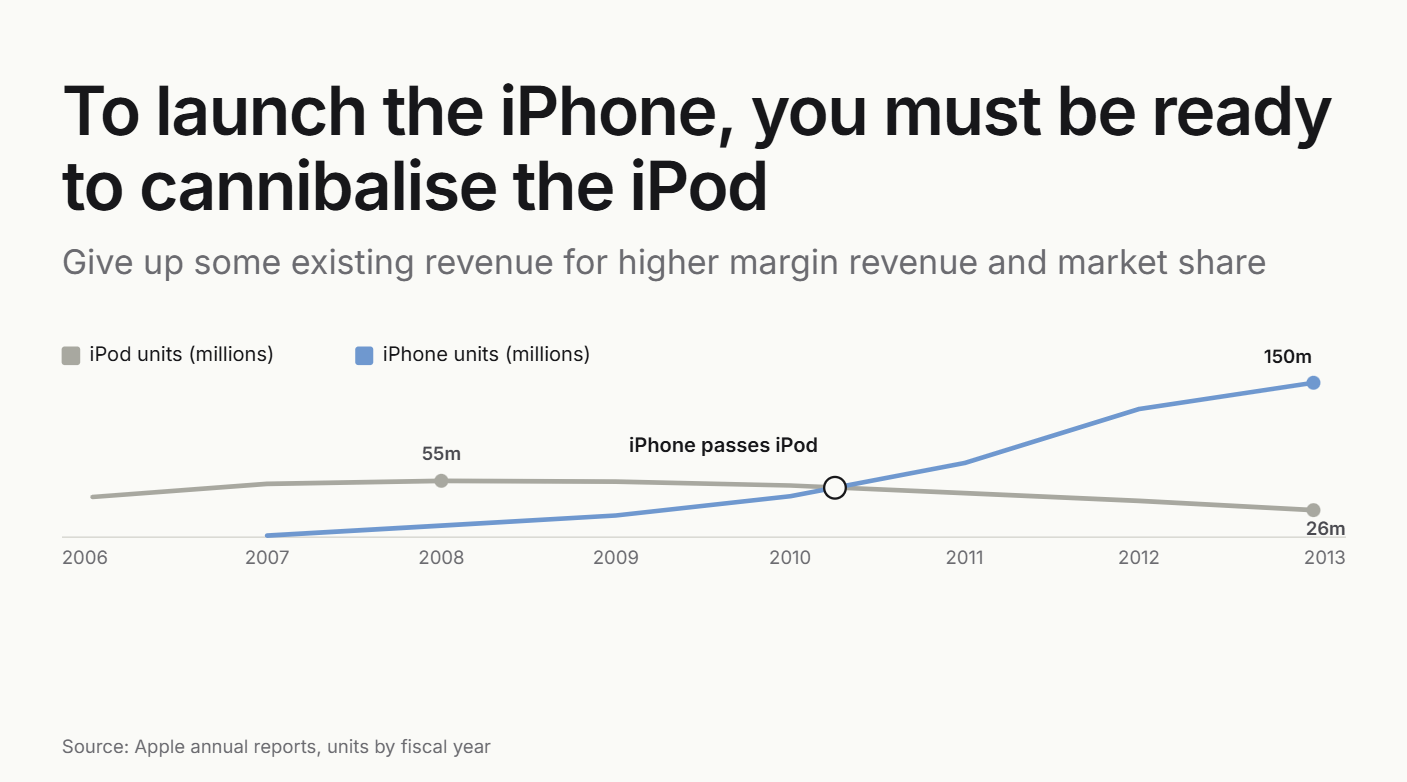
Law firms face the same choice:
The switch hurts before it helps. A productised service that takes half the time can halve the revenue from that work at first, before volume and margin catch up.
The partnership rewards this year’s profit. Partners near retirement carry the cost of cannibalisation but may not be there for the payoff.
Pay and credit run on hours. Utilisation targets, billable targets and origination credit all point the other way (more on this below).
Identity. Many lawyers see bespoke work as the point of the job. “Productised” can sound like “commodity”, even when the service is excellent.
It needs new skills. Scoping, pricing and process design are not taught at law school or rewarded in most firms.
The lesson from Apple is that cannibalisation may be painful but the alternative is worse. If a firm won’t productise its Run the Company work, an AI-native firm or the client’s own legal team will.
How to launch a productised service
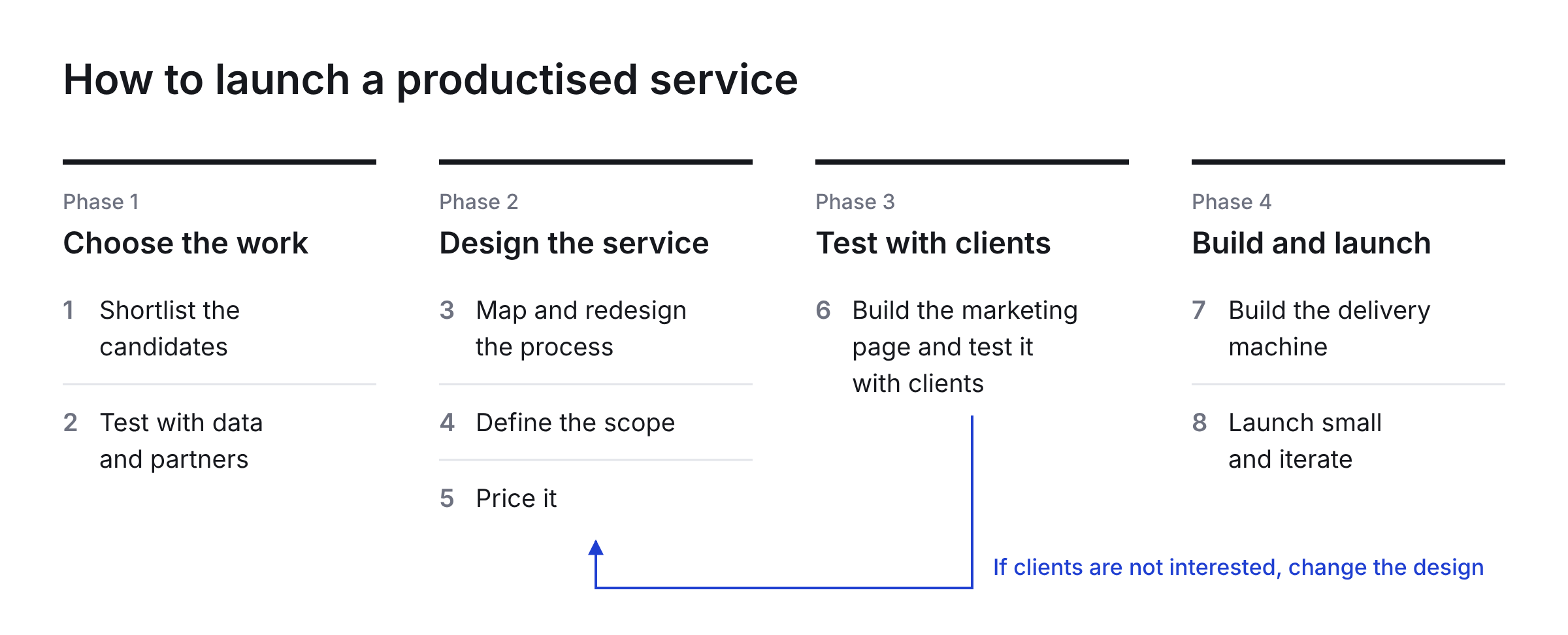
Here is the approach I am taking with clients. It runs in four phases: choose the work, design the service, test it with clients, then build and launch.
Phase 1: Choose the work
1. Shortlist the candidates
Look for work where:
Clients already push back on the bill, or ask for caps and fixed fees.
Margins are already being squeezed. Leadership teams already know which practice areas are likely candidates here.
The same problem comes up again and again, across many clients or many times for one client.
The client cares more about price, speed and certainty than about who does the work.
Most of the steps are procedure, with a few clear points where judgement matters.
AI can do a large share of the production, so the cost to serve is falling.
If a piece of work ticks most of those boxes, it is a good candidate.
Then describe each candidate as a client problem. Law firms define the world around practice areas. Don’t start there. Start from a problem that a specific type of client has, again and again. “Help a Series A company get its employment paperwork compliant before due diligence” is a job. “Employment law” is not.
2. Test the shortlist with data and partners
You need both quantitative and qualitative analysis here. Start with the numbers. Your time records are the best evidence you have. They show:
How the work is done today. Who does what, at what grade, in what order, and where the hours really go.
How much of it is repeatable. How often the same type of matter comes up, and how much the hours vary from one matter to the next.
How profitable each type of work is. Which work types make money today, which get written off, and where clients already push back on the bill.
The catch is that time records are messy. Narratives are free text, matter types are often wrong, and almost nobody records time per phase or task in a disciplined way (especially outside of litigation). My team and I recently built a tool that solves for this - it uses AI to turn messy raw data into structured information on matter types, workstreams and task types - then explores AI exposure per task, and profitability trends between practice areas and work types. Firms can also build future facing scenarios to see how industry developments will impact their work. (There’s admittedly a slight irony here in that we sell this both as a SaaS product but are also packaging it as a productised service in our consulting engagements!)
In parallel, talk to the partners and the people who do the work. This isn’t about cornering partners with a time export and proposal to commoditise their practice, so much as having an open conversation about how their team is using AI, how client demands are shifting, and how they want to grow their practice in the years ahead. Nothing happens without partner buy-in. By the end of this phase, you should have one or two candidates you are confident about.
Phase 2: Design the service
3. Map today’s process, then design tomorrow’s
Start with how the work happens now. What you learned in step 2 gives you a head start on this part.
Visually map the current flow. Lay out each step from instruction to completion: who does it, how long it takes and where it gets stuck. (At a practical level: white boards, or have an AI tool build you an interactive flowchart. I am increasingly doing the latter because you can drill down into detail in a way that isn’t possible with a whiteboard. Plus, my handwriting is awful.)
Looks for bottlenecks, identify improvements. Look for steps to remove, standardise or hand to AI, and for the handoffs where work gets stuck. Mark the few points where a senior lawyer’s judgment really matters.
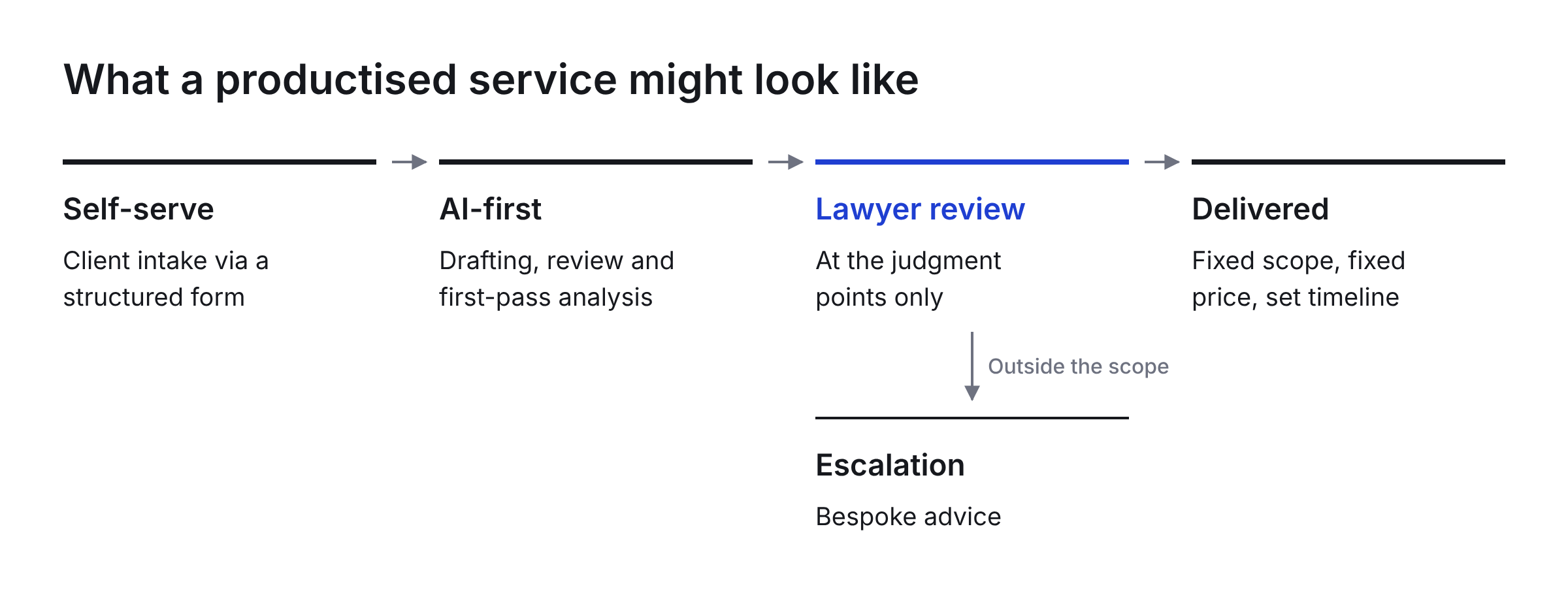
Design the future flow. Again, a whiteboard or interactive flowchart. Most good productised services end up with layers:
Self-serve for intake and information gathering (a structured form, or meeting the client in their tool, not an email chain).
AI-first for drafting, review and first-pass analysis.
Lawyer review at the judgment points.
Escalation to bespoke advice when something falls outside the scope.
4. Define the scope, and especially the exclusions
Write down exactly what is included, what is not, and what assumptions the price depends on (number of parties, number of documents, jurisdictions, rounds of comments). Bonus points if you can use technology to automatically flag out of scope items, or when assumptions get triggered.
5. Price it
There are usually two ways to come at the price.
The cost of production (your floor). Work out what it really costs to deliver the service: the hours at each grade, at cost rather than charge-out rates, plus the technology and overhead the service carries. Start from historical data, then adjust for what AI now does. (Many past matters pre-date AI, so their hours may overstate today’s cost.) The same benchmarks help here, because you can model the effect of AI on hours against your own grade mix. Add the margin you need, and you have the lowest price you can live with.
The value to the client (your ceiling). Then ask what the outcome is worth to the client. What would it cost them to do the work in-house, or to buy it elsewhere? What do speed and certainty save them: a deal that closes a week earlier, a regulator kept happy, a budget they can plan around? What have they paid for the same work before? That tells you the most a client will pay.
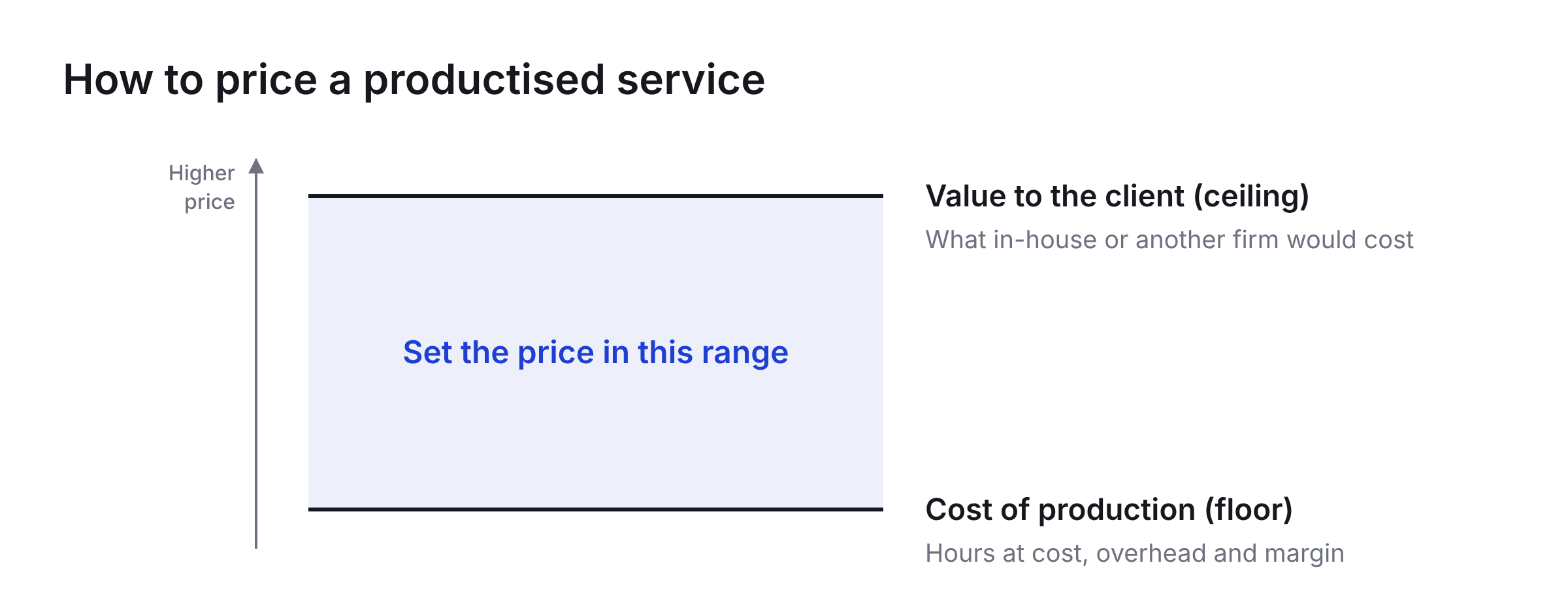
The price usually sits somewhere between the two. Then choose the shape of the price - for example:
A single fixed price for simple, well-bounded jobs.
Tiers (for example, standard, enhanced and premium) for jobs where complexity varies in predictable ways.
Subscriptions for recurring needs, such as a monthly contract review allowance.
A slice of the outcome (but this is still really hard to do for lawyers)
Whatever you choose, test the number with clients in step 6 before you commit to it.
Phase 3: Test it with clients
6. Build the marketing page/PDF and test it
This is your minimum viable product. Before you build anything else, write the page a client will see: a name that describes the outcome, a one-paragraph description, what they get, how long it takes and what it costs. If you can’t describe it in a paragraph, the scope is not tight enough yet.
Then show it to five or ten clients. Would they buy it? At that price? What is missing, and what don’t they need? Their answers will change your scope and your price, and it is far cheaper to change a web page or PDF than a workflow. If the answers are lukewarm, go back to phase 2, or to your shortlist.
Assume people will be overly nice when giving you feedback, so weight their feedback downwards and beware hearing what you want to hear. Anything less than 8 out of 10 definitely isn’t good enough. Ideally 9 or 10.
Phase 4: Build and launch
7. Build the delivery machine
This is where the margin comes from. You need templates, playbooks, a standard workflow, a quality check and clear service levels. You also need a way to see every live matter, where it is stuck and how its actual cost compares with the price. This, of course, is what we do at Lupl.
8. Launch small and iterate
Pilot with a few friendly clients. Run an NPS. Track the actual cost of every matter against the price. Your first price will be wrong, and that is fine if you find out quickly. Then improve the next version. Manage it the way a software company manages a product, with a roadmap and regular improvements, not as a one-off launch.
What this means for different players
For law firms, the opportunity is to pick two or three offers where you already have volume and reputation, and do them properly. A small number of well-run productised services will teach you more than a big transformation programme.
For in-house teams, there are two angles. As buyers, you can push your panel firms to offer productised services and compare them on a like-for-like basis. As builders, you can productise your own internal services, such as self-serve NDAs or a standard contract review process for the business.
Final thoughts
Business model change always lags technology change. The technology is currently well ahead. The firms that use the next year or two to design a few good productised services will be in a much stronger position than those who keep trying to force all legal work down the bespoke channel.
Sources and further reading
Richard Susskind, The End of Lawyers? Rethinking the Nature of Legal Services (OUP, 2008), and Tomorrow’s Lawyers.
David Maister, Managing the Professional Service Firm (1993).
Harvey raises $550M at a $15.5B valuation (Harvey, 9 September 2026).
Goodbye iPod, hello iPhone (Fortune, August 2009).